North Museum has historic seed, plant specimen collection – and you can see parts of it soon
KARYL CARMIGNANI | For LNP | LancasterOnline
A collection of seeds from the North Museum, normally stored in the basement, will go on display March 20. Many of the seeds are tree nuts, including kumquat, lemon, grapefruit and tangerine.
Many Lancaster County families are already familiar with the North Museum’s natural wonders, from its live animal room to its planetarium. But did you know the museum is also home to well over 30,000 plant specimens — including a historic seed collection?

Molly Wolanski, exhibits and collection manager at the North Museum, knows the collection well. They’ve been with the museum since 2021, where their daily tasks can range from everything from “crocheting hats for dinosaurs, or dealing with an escaped snake,” Wolanski says. (The latter, by the way, has not happened since they upgraded the reptile enclosures.)
The pressed plants in the collection are mostly local specimens, Wolanski says. Dating back to the 1820s and 1830s and pressed onto paper just as old, they are exceedingly fragile. The seed collection came from a local dentist who had a penchant for plants. While the plant and seed collection is only available for research appointments, the public will soon get a glimpse of some of it.

Wolanski says they are excited to “pull vials of poisonous plant seeds” like castor beans for the upcoming exhibit “Nature Reimagined” open to the public March 20 through July 5. This exhibit explores the wild world around us through three smaller exhibits: Insects Reimagined, Journaling Nature and Poisonous Plants.
“This show features a variety of art forms featuring more traditional fine art media, fiber arts, and actual insects,” says Wolanski in an email. The Poisonous Plants portion explores the often maligned and feared plants we find in our world and the surprising history and science of these poisons, they add.
Plants featured will include poison hemlock, mountain laurel, rhododendron, deadly nightshade, and potato (the only edible part of the plant is the tuber; all green parts are toxic). Also, on display will be portions of the museum’s Materia Medica cabinet containing medicinal — and not-so-medicinal plants — from the 1800s, which was used in training new doctors in various remedies.
NATURE REIMAGINED
“Nature Reimagined,” opening March 20, will feature three exhibits: Insects Reimagined, Journaling Nature and Poisonous Plants. The latter will include 12 photographed pressed plant specimens from the herbarium. “Many people don’t realize how morbid natural history can be,” Wolanski says.
“Nature Reimagined” will include a cabinet from the 1890s which was used for pharmacy teaching. So many plants considered poison were used as medicine, Wolanski says. Or food. For instance, the “humble potato” is part of the deadly nightshade family (aka belladonna), a toxic perennial herbaceous plant, so centuries ago, folks were reluctant to eat it. “It took a while for the potato to become a culinary mainstay,” Wolanski says.
Groff’s seeds
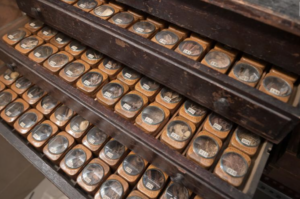
H.K. Groff, a local dentist, collected and methodically organized seeds in antique wooden cabinets. His “active collection and curation years” were 1939-1952, Wolanski says. Groff was also an ardent volunteer at the Stahr Hall Museum, the precursor of North Museum, and a passionate “amateur botanist,” the term used at the time. With 4,423 species of plants, the Groff seed collection represents species from around the country and beyond. “He tried to get a little of everything from around the world,” Wolanski says. Peering at the plethora of seeds, the diversity is unmistakable. Wolanski marvels at the different shapes of acorns: some are long and skinny, some short and round. The caps are also different.
“Often we look at plants in nature in isolation from their taxonomic relatives, and once they are grouped together it’s easier to compare and contrast their differences,” Wolanski says. The seed collection “is almost like a physical, nonportable field guide or library.”
The seed drawers are neatly divided with each vial and baggy (for jumbo seeds like acorns) labeled with a number indicating plant family, the species, and where it was collected. Wolanski says that Groff had a “unique numbering system”; the seeds are also listed in a modern-day spreadsheet. While Groff was an avid seed collector, seeds collected by other botanists have been stored with his, with some dating back to the 1860s collected by Abram P. Garber, adds Wolinski.
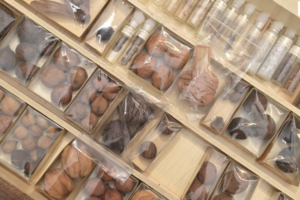
Wolanski says that while some botanists had “surprisingly nice handwriting,” it was still a relief when people started using a typewriter for specimen labels. They say that the pool of people able to read cursive handwriting is shrinking with many schools doing away with teaching cursive. But “1800s cursive is a different beast,” they add. Wolanski explains that the seeds in the collection are vintage seeds, not heirloom seeds which exist through Natural Selection. “This is a record of plant seeds from around the 1900s, au natural.”
The herbarium
In addition to the carefully catalogued seeds, the North Museum also has a significant herbarium — a collection of plant specimens and data used for scientific study. The 1986 keepsake book “The North Museum and the Natural History Tradition of Lancaster County” says that “given the size of the North Museum, the herbarium is impressive” and ranked it the fourth largest in the state of Pennsylvania.
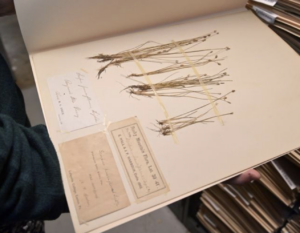
The herbarium contains flowering and non-flowering plants like ferns, mosses and algae. The seed collection has been “particularly useful to archaeologists as a reference for plant utilization by prehistoric American Indians,” says botanist Jane Grushow in the book. “The herbarium is in fact a testimony to the great plant diversity that once existed in Lancaster County. Sadly, many of the wild places recorded in the herbarium have been built upon, drained, or used as dumps or landfill, thus destroying the original plant life,” Grushow adds.
For instance, there are diverse seed specimens — 177 records — from the Dillersville Swamp, an area now covered in housing and mall development. Wolanski says the oldest specimen was collected in the 1860s by Thomas C. Porter, another renowned botanist.
“There are over 100 species represented in those 177 samples,” Wolanski says. “There are common garden favorites like pussy willow, orange coneflower, and black-eyed Susan, as well as other native species like skunk cabbage, goldenrod, and poison sumac.” Wolanski says they used to see murders of crows circling above in the Dillersville area. Could the birds be recalling their wild ancestral habitat of yesteryear? “In this time of rapid change, we need to know what was once there, to help protect what’s left,” Wolanski says.
A moss collection made by Thomas Porter, a professor at Franklin & Marshall College, are dehydrated specimens in individual packets. Wolanski says that moss pre-dates roots and seeds. “It’s one of the original forms of plant life on land.”
Be your own botanist
Plant specimens are no longer being added to the North Museum’s herbarium; rather, they are being preserved for future scientific endeavors. Wolanski says that while the amateur botanists documented where the specimen was collected, “they didn’t have specific geo-data back then.” These days, the exact longitude and latitude would be noted — a cell phone photo of the specimen contains the geo-data automatically.
Wolanski recommends the phone app iNaturalist for newbies to learn what they’re looking at by taking a photo. Once in the app, “your photo could be included in a research study.” Wolanski says SEEK is a good app for younger naturalists.
And, of course, a visit to the museum can help further bolster their scientific knowledge.
“We’re here, we exist, come visit North Museum to learn about the natural world and what we have before it’s gone,” Wolanski says.
KARYL CARMIGNANI | For LNP | LancasterOnline